Music to my Ears

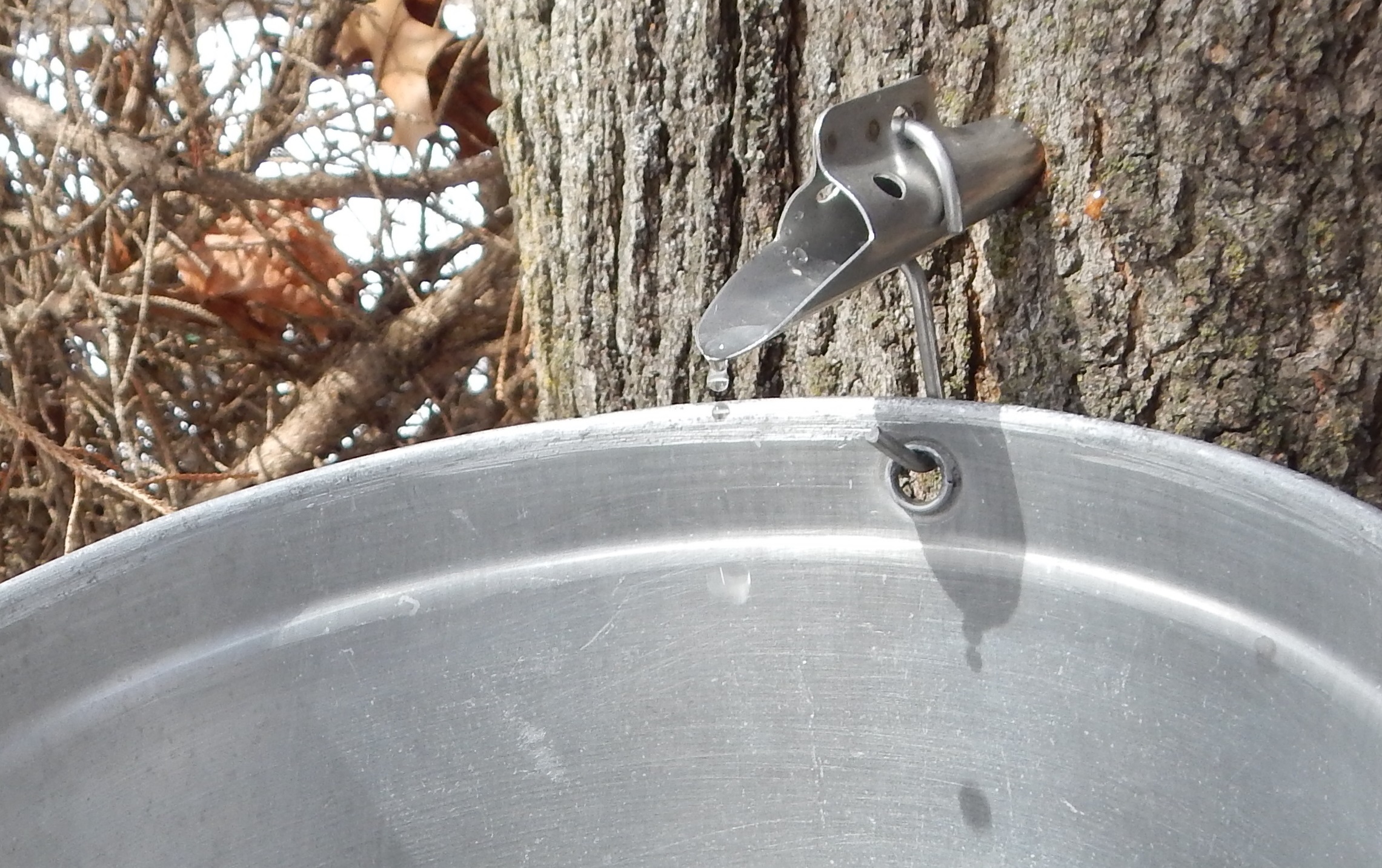
Sweet sap dripping from a maple tree

Spring sun gently warming the trees quickens the sap flow.  Plunk, plunk, plunk.  Sounds of droplets hitting the bottom of the buckets echo through the woods as the contents are collected and the buckets re-hung.

Sunny days of gathering, with crisp weather hovering at about the 3 degree Celcius point are wonderful days to be out in the woods.  Such days engage my senses.  I get to view nature in its purest, capture snapshots of tranquillity as I set out to gather this day’s harvest.  Sun glistens off of the snow, light sparkles through icicles.  Sap tastes like sweet snowflakes.  As I progress, a calming steady rhythm begins -droplets of sap hitting the bottom of buckets.  The beat picks up the more buckets I empty – plunk plunk plunk, plunk plunk.  It turns into an orchestra of plunks with me as maestro.

Boiling Day Preparation

Big days in maple syrup production are the boiling days.  I should preface that statement, noting that ALL days in maple syrup production are big days from the many labor-intensive duties the process requires (fuel needs to be collected, the trees need to be tapped, the sap needs to be continually collected, the equipment needs to be sterilized), but I deter.  The BIGGER days in maple syrup production are boiling days.  As can be deduced from what is described below, it takes a lot of preparation!

Boiling days typically last from 8am to 3pm or later.  On boiling days, one needs enough firewood to feed the fire in the evaporator approximately once every two minutes.  For a full day of boiling that requires a lot of wood.  To know roughly how much wood we will require let’s do bit of calculation: now, a cord of wood is defined as 12 inch pieces of wood piled 4 feet deep, by 4 feet high, by 8 feet long.  Maple syrupers say that when using dry, split hardwood, evaporator efficiency is about 25 gallons of syrup per cord; 15 gallons of syrup per cord with dry, split softwood.  We’re using some soft and some hardwood so I’ll average it out and say 20 gallons/cord.  We have bout 125 taps up that will each produce on average 20 gallons of sap over the season.  This will yield a grand total of 1875 gallons of sap (20 gal. x 125 trees = 2500 gal.).  Divide that yield by 40 (40:1 sap:syrup ratio) and you get 62.5 gallons of syrup.  Finally, divide 62.5 gallons by ~20 gallons per cord and you get 3.12 cords.   All that is to say we will need a little more than 3 cords of wood this year.  Now, all of these calculations are based on dry wood.  This means before the boiling even takes place enough damaged trees need to be cut down and cut into logs which are then split, stacked, and dried.  Drying wood takes more than a weekend, or even a month.  Drying takes about a year of sun shining down on the wood, slowly evaporating moisture from the densely packed wood fibres.

Tree Cutting

Making maple syrup is not for the faint of heart. It requires lots of work, including felling, cutting, splitting and stacking wood for fuel the following year.

This year is going to be a bit unconventional for our maple syrup production.  Since we just bought our evaporator this year, we don’t have that much stacked and dried fuel set aside specifically for burning in the evaporator.  Luckily, we have some extra that hasn’t been used to heat the house this year that we can use for evaporator fuel.  To be better prepared for next year my Dad and I have been in the bush a number of times lately, felling dead trees for fuel, cutting the wood into logs and splitting and stacking the wood to dry.

On boiling day, dry fuel wood burns furiously.  The chimney attached to the rear of the evaporator in the sugar shack rises high above the roof-line to catch the airflow of the wind.  This airflow draws the flames from the firebox of the evaporator, stretching the flames from the ‘arch’ as maple syrupers say, toward the back of the evaporator to the chimney.  Since the evaporator is so long and the fire is positioned near the front, the flames get stretched/drawn-out almost horizontally towards the chimney, to almost a metre in length at times (witnessing the power of the blaze once it gets going is awe-inducing and makes me very glad we mounted a fire extinguisher on the wall within an arms reach for if things were to go awry!).  It is this draw from the chimney that heats the length of the flue pans that sit atop the firebox and increases the efficiency of an evaporator.  If wet or green wood were to be used instead of dry wood, the crisp, roaring fire that makes an evaporator so efficient would be replaced by a smoldering, smoking mess.  Smoldering wood does not create nearly enough heat to evaporate sap into syrup, hence all the fuel preparation maple syrup requires!
Maple Bush

Maple Bush

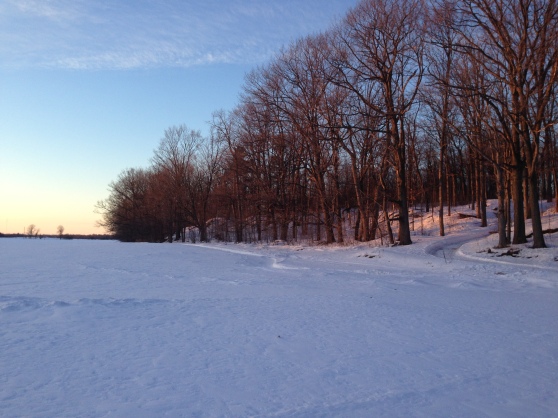
As twilight falls, the maple bush burns a mesmerizing pink or gold color. Do not be fooled by the warm colors though: there was nothing warm about the biting temperature!

Our path winds along the side of a field, then cuts into the forest and climbs the slope of the ridge. The path curls through the trees, strategically passing by stands of maples for easier collection in the early spring when snow drifts hinder bucket brigading efforts that our traditional maple sap collection process involves. The warmer temperatures in early March certainly had us fooled – after I motivated 4 family members to help tap some trees the temperatures plummeted to lows of -20C some nights. Getting to take in views like this help make up for my over-eagerness I hope!

Spring Thaw, Maple Melt

Maple Sugarer: A person who taps maple trees to produce maple syrup and other maple flavored products.

As the days get longer and the temperature warms one can tell spring is in the air.  After a long winter of being cooped up indoors to escape the cold, many jump at the chance to enjoy the outdoors again in warmer temperatures.  The tell-tale drippings of melting snow signify a lesser known event as well – the beginning of maple syrup season.  When the temperature raises above freezing during the day and below freezing at night, sap that has been kept in safekeeping in trees’ roots starts flowing up and down the thick trunks of maple trees as Mother Nature prepares the forest for growth.

Maple sap comes from tapping trees in the springtime during that flow, or run as maple sugarers call it.  Traditionally, to tap a tree one drills into the trunk two inches and fills the hole with a spile or spout.  A bucket is hung from a hook attached to the spile.  This allows the maple sap to run out of the spile and fall into the bucket.  

Drip, plunk, drip, plunk, drip, plunk.  The sound of the forest during maple syrup season has a calming quality to it.  It is easy to be mesmerized by the sound.  However, there is little time for that since the run happens for such a short time of the year.  Whomever coined the sap flow a ‘run’ knew what they were talking about – for about 6 weeks sugarers are running around the forest in a frenzy tapping, collecting sap once, maybe twice a day and then spending a full day boiling down the sap in a sugar shack every few days until it reaches just the right density to make syrup.  

Evaporators are used often to boil down maple syrup.  Evaporators are specially made units to increase a fire’s heat efficiency, in this case to make maple syrup.  They can range anywhere from 2 to 12 feet long, depending on the size of one’s operation.  Evaporators have an arch, where the fire is started and the wood is loaded in to feed the fire.  On top of the arch are a set of pans.  These pans have flues in them, little raised inlets which increase the surface area of the pan and this is where the increased efficiency comes from – the more surface area of the pan, the faster the sap evaporates. On boiling days steam rises off the pans in clouds and comes billowing out vents at the top of sugar shacks like clouds of maple-flavored cotton candy!

When the boiling is done everyone breathes a big sigh of relief!  Until it needs to be done again, that is.  The run is a busy time indeed!